


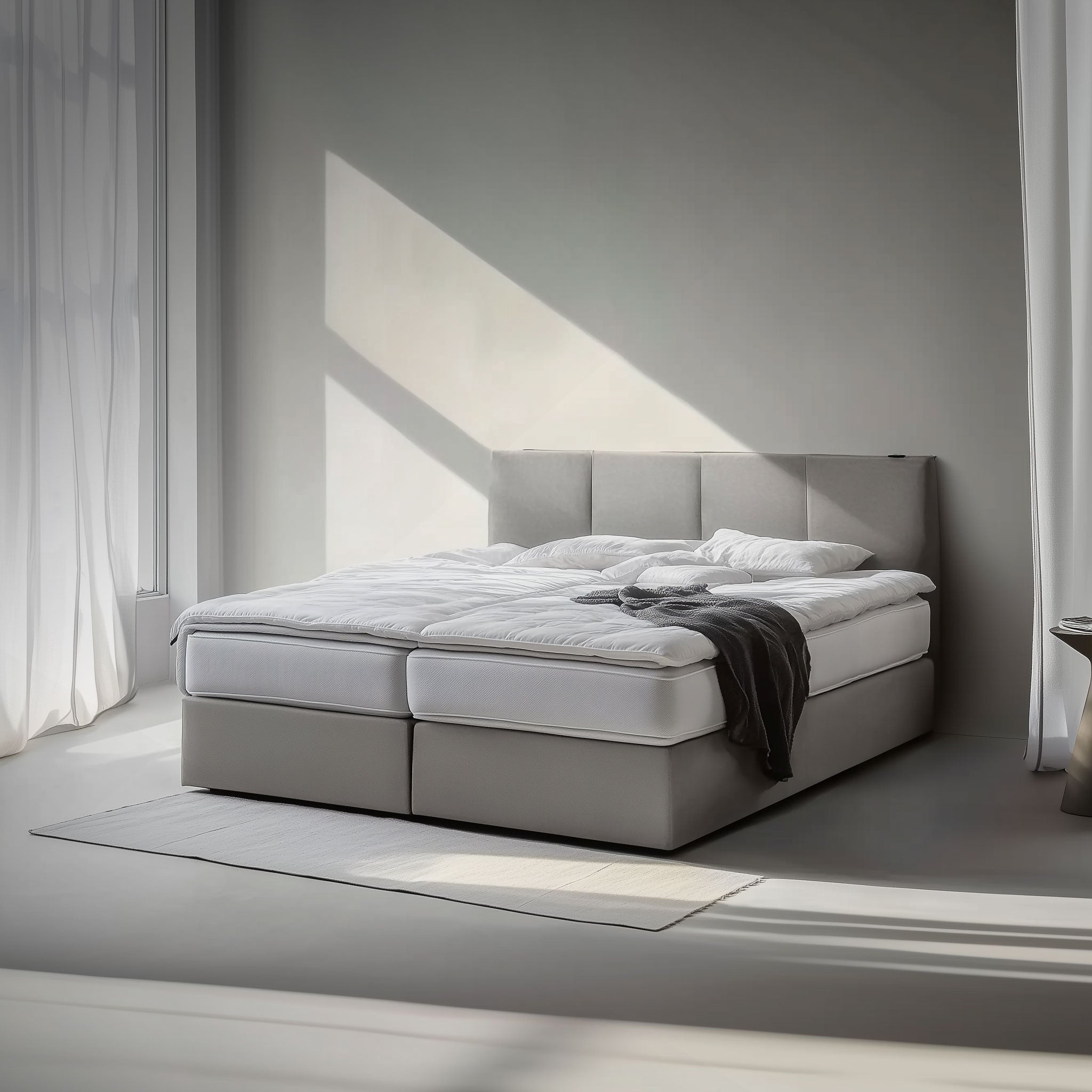
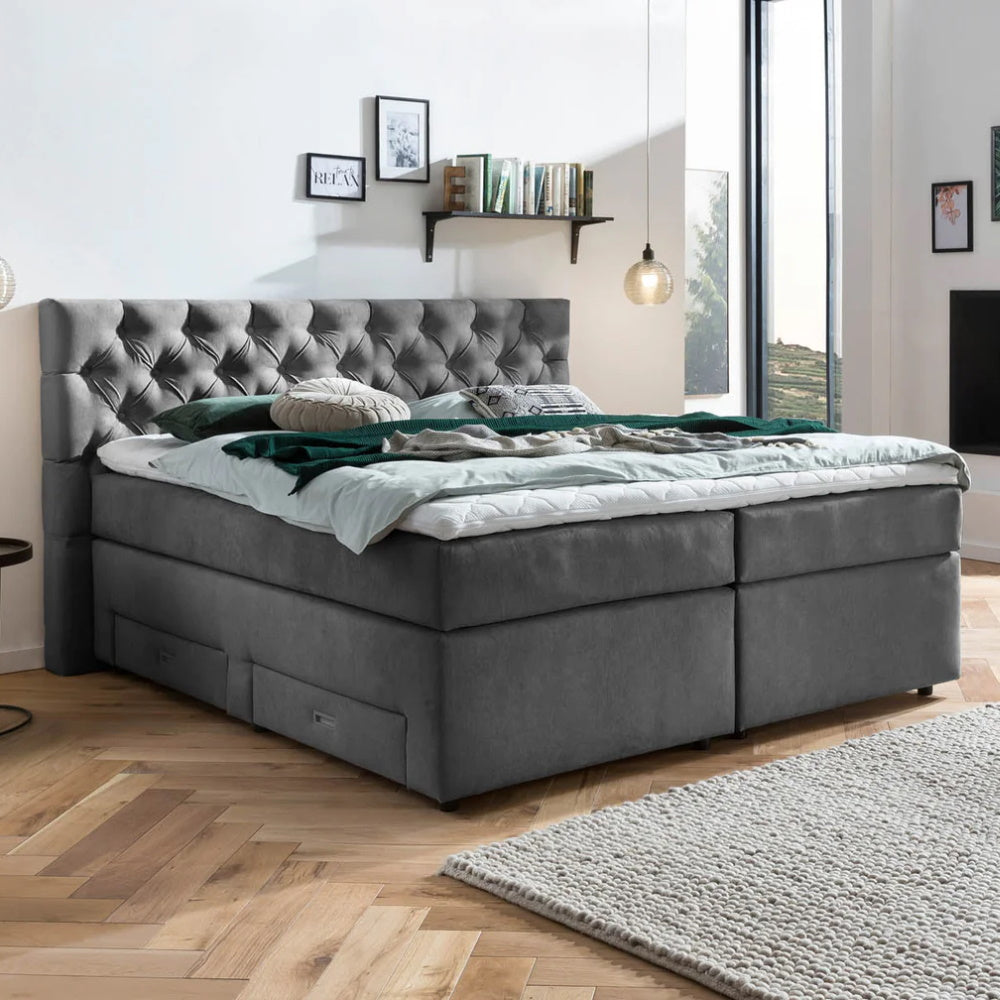
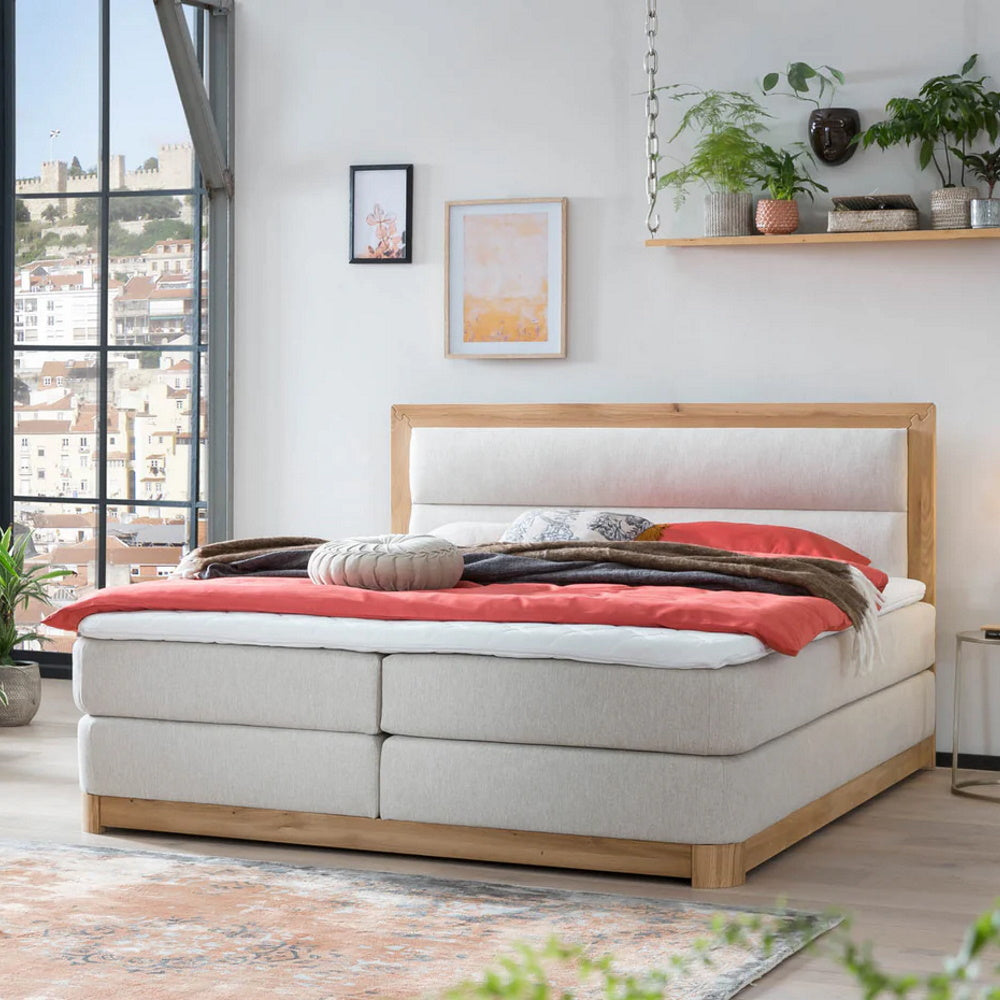
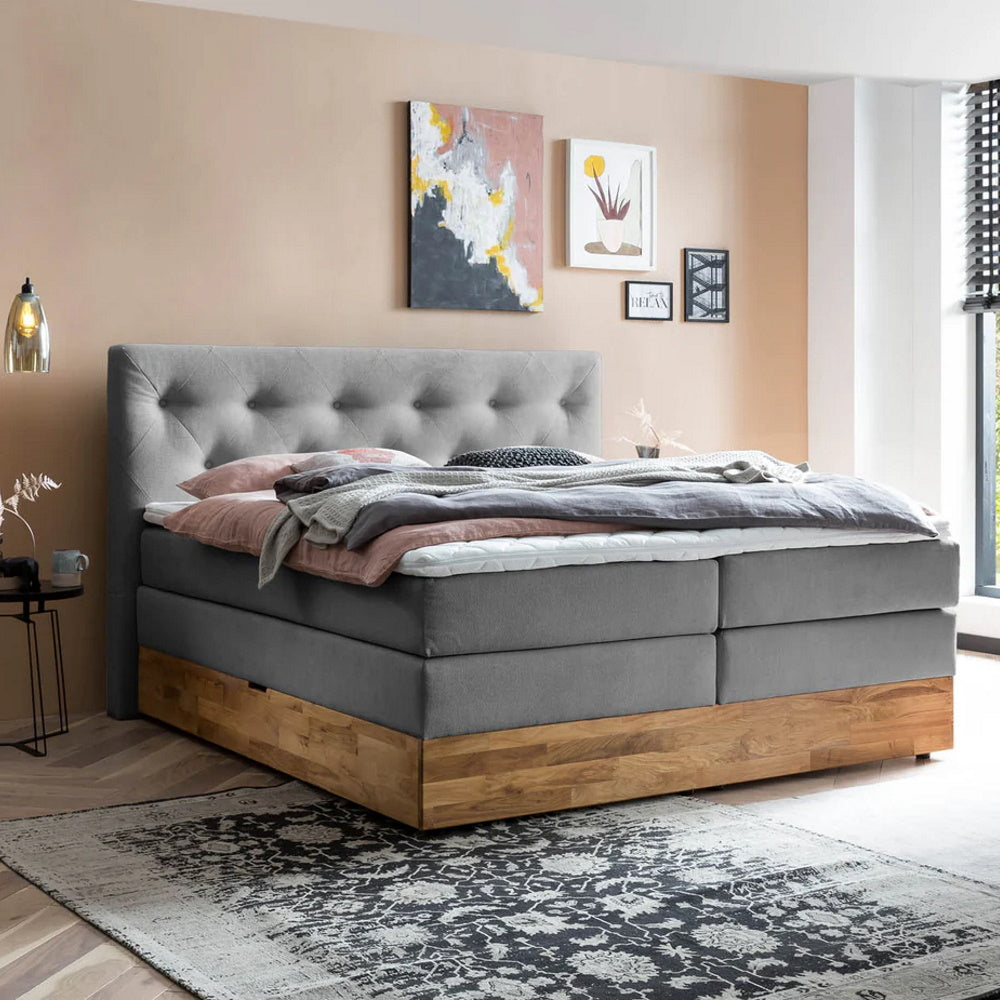

Box spring bed or slatted frame ? Sounds like a simple either-or question – but in reality, it's a choice between two completely different sleep systems . Between a modular bed structure, made up of a frame, slatted frame, mattress, optional topper, and protector. And an integrated system where the box spring, mattress, and topper mesh together like gears.
What many only realize when buying a bed: it's not the design that matters, but how much of a system your sleep needs. A bed with a slatted frame works like a construction kit: you choose each element individually – and everything has to harmonize to ensure a comfortable sleeping experience. With a box spring bed, on the other hand, the coordination is inherent in the design: springs at the bottom, a spring core in the mattress, and a topper on top. Three layers, one result – ergonomically designed and conceived as a single unit from the outset.
That's precisely why it's worth choosing between a box spring bed and a slatted bed frame not on a whim, but with a structured approach. In this guide, we examine both systems in a way rarely seen in the furniture market: without myths, without embellishment, but with a clear understanding of comfort, construction, and a true fit.
Table of contents
- The Quick Guide: Box spring bed vs. slatted frame
- Box spring bed or slatted frame: Two systems – two ways of thinking
- The bed with slatted frame: your personal modular system
- The box spring bed: a coordinated overall system
- Box spring bed vs. slatted frame – a compact comparison
- Ergonomics & sleeping comfort: Is it better to sleep on a box spring bed or on a slatted bed frame?
- Design & spatial effect of a bed with a slatted frame vs. a box spring: What really determines the look
- Box spring bed or slatted frame? Your sleep, your choice.
- FAQ on the question: Box spring bed or slatted frame
The Quick Guide: Box spring bed vs. slatted frame
- Box spring bed = complete system: box, mattress and topper are coordinated with each other.
- Slatted bed frame = modular system: frame, slatted base and mattress are assembled individually.
- The comfort of lying down always comes from the quality of the materials – not from the system type.
- The key factors are: body profile, entry height, spatial effect, and how much coordination you want to do yourself.
Box spring bed or slatted frame: Two systems – two ways of thinking
If you're wondering whether a box spring bed or a bed with a slatted frame is better for you, it's worth taking a look at the core principles of both concepts. This is where it's determined how your sleep system will function later: modular or integrated.

The bed with slatted frame: your personal modular system
A bed frame alone doesn't create a comfortable sleeping experience. With a classic slatted frame system, you assemble your sleep setup piece by piece yourself:
- a bed frame
- a slatted bed base (rigid slats, flexible modules, adjustable or not)
- a mattress (foam, latex, innerspring – each in numerous variations)
- Optionally, add a topper if you need it softer.
- a mattress protector , also optional
Everything can work very well together – if the components are compatible. And that's precisely where the challenge lies: even small differences in firmness and zoning, combined with the bed frame, can completely alter the sleeping experience. Some slatted frames push the mattress upwards too much, while others give way too quickly. Some mattresses only work on specific frames – and an incorrectly chosen combination can cost you unnecessary energy at night.
With this system, you have maximum freedom , but also maximum responsibility for the "matching" of all components.
It's great when you:
- You have very specific mattress preferences
- like to adapt, exchange, or experiment
- prefer a minimalist bed frame
- You like low bed heights.
The box spring bed: a coordinated overall system
A box spring bed works differently. It's not assembled, but constructed. All elements function as a cohesive unit from the very beginning.
- The box with spring core provides elastic support from below.
- The spring mattress provides precise support for your body.
- The topper forms the comfortable surface and determines the fine-tuning of the lying sensation.
Herein lies one advantage of the box spring bed : you don't have to combine anything or have anything "adjusted". The system is self-contained – and that's precisely what creates that special blend of softness and stability that many describe as a "hotel feeling".
The result: You are not lying “on” the bed, but in a coordinated system that adapts to your body profile.
It's great when you:
- You want a harmonious, peaceful feeling while lying down.
- You want to get up more easily in the morning (due to the altitude)
- as a couple you want less motion transmission
- You are sensitive to pressure (shoulders, hips, back)
- you want a bed that "fits together" right out of the box
Box spring bed vs. slatted frame – a compact comparison
Sometimes a quick glance is all it takes to make the differences tangible. Here you can see the most important facts at a glance – without technical jargon, but precise enough to clarify the decision between a box spring bed and a slatted frame system:
|
Area |
Box spring bed |
Bed with slatted frame |
What does that mean for you? |
|
System structure |
fixed 3-layer system (box, mattress, topper) |
Modular construction consisting of several individual components |
Box spring bed: fewer configuration options. Slatted bed base: more freedom of choice. |
|
Entry height |
higher constructed |
Depending on the frame, often lower |
The height affects getting in and out – depending on personal needs. |
|
Motion transmission |
Suspension distributes movement across multiple levels |
Movement depends heavily on the mattress and bed frame. |
You notice the difference most when you're with someone else – not better or worse, just different. |
|
Sleeping environment |
air-permeable due to spring cores |
depending on the mattress material |
Spring cores tend to cool down more, while foam tends to retain heat. |
|
noises |
few moving parts in the substructure |
Depending on the model, the slatted bed base/bed frame may develop noises. |
Noise levels vary depending on the model and quality. |
|
Care |
Focus on mattress rotation & topper ventilation |
The mattress and bed frame should be checked regularly. |
Both systems need maintenance – just in different forms. |
|
Price structure |
Total price for system |
Individual prices for multiple components |
The price of both depends heavily on the quality of the materials. |
Box spring bed or bed with a slatted frame? Both systems have their own strengths. The crucial factor is not which is "better," but which suits your sleeping habits , your body, and your perception of space.
Ergonomics & sleeping comfort: Is it better to sleep on a box spring bed or on a slatted bed frame?
Whether it's a box spring bed or a slatted frame: comfort never comes from a single element, but from how all the parts work together . That's why box spring beds and slatted frame systems feel different – but neither automatically wins.
A slatted bed base setup depends entirely on its mattress. The mattress determines how softly your shoulder sinks in, how stable your back is, and whether the overall experience is harmonious. The base helps – but only if both are truly compatible . Sounds simple, but it isn't always.


With a box spring bed, this task is distributed across three levels . The box provides springs, the mattress offers point elasticity, and the topper perfects the sleeping experience. For many, this feels more consistent because the system is designed as a single unit and doesn't require individual assembly.
Therefore, it's not the bed system alone that determines ergonomics, but rather the quality and coordination of the materials . When everything is clearly designed, you get a sleeping experience that simply makes sense. This is precisely Belanoti's approach: the box, mattress, and topper are coordinated so that you don't have that "I hope this all fits together" feeling, but rather a system that works as a whole.
Design & spatial effect of a bed with a slatted frame vs. a box spring: What really determines the look
With a slatted bed base, the frame almost exclusively determines the look. Floating, delicate, solid, wood, metal, Scandinavian or minimalist – the appearance is created by the frame, not by the system underneath. This allows slatted bed bases to be integrated very flexibly into the bedroom's design.
With a box spring bed, the look is an integral part of the system that so many people love: the closed construction, the clean lines, and the continuous headboard automatically give the bed more presence. Fabric, color, and height change the style, but the form remains typical of a box spring . Even if you choose a box spring bed with wood , this creates an exciting contrast to the fabric-covered frame and headboard.
And: With an electrically adjustable box spring bed , the technology remains completely invisible. Motors, drive, and mechanics are integrated into the system, so the bed retains its look – without visible elements or technical interruptions.
Box spring bed or slatted frame? Your sleep, your choice.
If you like a calm, even lying sensation, find the high entry height practical, or simply want a bed where everything is already coordinated, you will often feel more comfortable in a box spring bed.
However, if you like to combine things yourself, prefer a lighter bed frame, or are looking for a very specific mattress, a slatted frame setup may be the better choice.
The only important thing is that you truly relax at night. And if you're currently torn between the two options or unsure which feels right for you , just get in touch. At Belanoti , we'll listen, ask questions, and help you figure out which system suits you and your sleep best. Ultimately, the decision is yours – not the label "box spring" or "slatted frame."
FAQ on the question: Box spring bed or slatted frame
How can I recognize quality – whether it's a box spring bed or a bed with a slatted frame?
Good beds are rarely recognizable at first glance. More important than the type of system is how cleanly the materials are processed and whether the construction is logically designed.
Pay attention to:
- a stable frame construction (solid wood instead of particleboard)
- verifiable hardness level specifications
- High-quality fabrics and covers that do not thin out
- a spring core that is tightly constructed and does not "rattle"
- Clear information on the system's structure
- Honest information about the origin of the materials
And yes: This applies equally to box spring beds and slatted bed base beds. At Belanoti, we rely on European manufacturing, solid wood, and carefully selected fabrics. Not because it's marketing, but because quality can't hide at night.
Which firmness level suits me best – and does it matter whether it's a box spring bed or a slatted frame?
The correct firmness level depends less on the bed system and much more on you: your body weight, your sleeping position, and how "firm" or "soft" you want the bed to feel.
The following applies as a basic framework:
- H2 for lighter people or a softer sleeping feel
- H3 is suitable for most bodies and provides a balanced feeling.
- H4 for heavier individuals or very firm support.
The difference lies more in the coordination of the system: With a slatted bed frame, the feeling of lying down is created primarily by the interaction between the mattress and the frame.
The firmness level only works really well if both elements are in harmony: A flexible slatted frame can soften a mattress that is too firm, but a rigid frame can also make it feel firmer. The "fit" is crucial here.
With a box spring bed, the system itself contributes to ergonomics. The box, mattress, and topper work together – the firmness of the mattress is complemented by the springs of the box and the characteristics of the topper. The topper allows you to further fine-tune the feel without completely changing the firmness.
I have knee problems – would a box spring bed or a bed with a slatted frame be better for me?
When it comes to knee problems, the bed's height is more important than the sleep system itself. A higher bed makes sitting down and getting up significantly easier because you don't have to bend your knees as much – the movement is more like getting up from a chair. A box spring bed inherently has this height. This can noticeably ease everyday life, especially in the mornings and evenings when the joints are more sensitive.
A bed with a slatted frame can work just as well – but only if the frame is built high enough. Make sure it's a height that suits you. As soon as you can stand up without using momentum or any "support tricks," the ergonomics are correct – regardless of the type of system.
Which bed is easier to assemble – a box spring bed or a bed with a slatted base?
A box spring bed is usually quicker to assemble: the bases are in place, the headboard is screwed on, the mattress and topper are placed on top – done. The parts are large, but the system is almost completely pre-assembled.
Building a slatted bed frame involves several steps: assembling the frame, inserting the slatted base (or, in some models, first assembling it), placing the mattress on top, and possibly adding a topper. It's not complicated, but it often takes a little longer.


Leave a comment
This site is protected by hCaptcha and the hCaptcha Privacy Policy and Terms of Service apply.